
UX/UI · NEOGOV
User-Friendly Internal Software for Public Safety
Internal Police Software
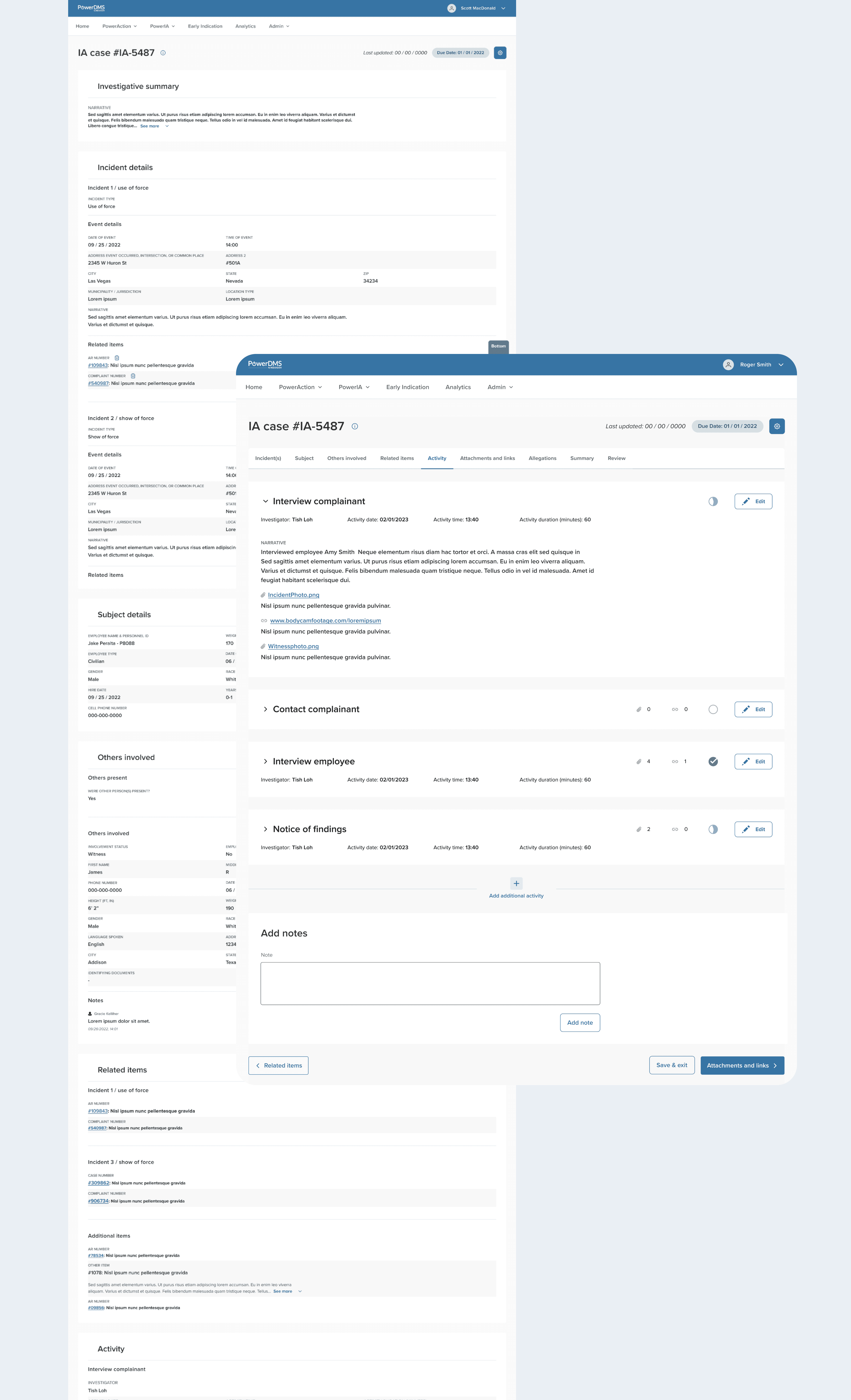
Designed an integrated case management system balancing officer workflows with CJIS compliance requirements through rigorous user research and multi-state validation.

Building a Modern Suite for Law Enforcement
NEOGOV partnered with Credera to design and build a greenfield application suite for police agencies. The platform enables officers to conduct internal investigations, create and review action reports, and analyzeagency-wide data — replacing fragmented, paper-based processes with a unified digital experience.
Public Safety
UX Designer
UI/UX Design
UX Research
Interaction Design
Design Systems
Prototyping
Officers, Investigators, Administrators
Internal affairs, action reporting, administrative tools, analytics, and design system contributions
View Live Site

Serving Multiple Users Across a Highly Regulated Industry
(Diverse Users)
Internal affairs, action reporting, administrative tools, analytics, and design system contributions
(Compliance Requirements)
The system had to integrate with dispatch data, honor agency policies, and maintain CJIS security standards.
(Fragmented Current State)
Departments relied on paper processes and scattered software with no standardized approach to reporting or case tracking.
(Scale & Customization)
The solution had to serve departments ranging from small rural agencies to large metropolitan forces, each with different jurisdictional needs.

Design a Scalable, Compliant, User-Centered Platform
(Unify Operations)
Consolidate internal investigations, action reporting, administration, and analytics into one platform.
(Simplify Workflows)
Transform complex investigative and reporting processes into intuitive experiences.
(Support Customization)
Enable configuration for diverse jurisdictions and policy requirements.
(Ensure Compliance)
Meet CJIS security standards and federal reporting regulations.
(Enable Scalability)
Architect for 17,000+ agencies and future market expansion.
(Accelerate Adoption)
Reduce training time and support rapid onboarding.

A Collaborative, Validation-Driven Design Methodology
(Discovery)
Conducted stakeholder interviews with law enforcement SMEs, industry analysts, and end users across four states. Observed real workflows and completed a comprehensive compliance requirements analysis.
(Architecture Workshops)
Facilitated intensive workshops with NEOGOV stakeholders, technical architects, and product owners to align user-centered design principles with system architecture.
(Wireframe Design & Iteration)
Created 100+ wireframes across four core products — internal affairs, action reporting, and admin tools— with 3–4 validation cycles per screen.
(User Validation)
Conducted 72+ feedback sessions with an SME user council of officers, investigators, and administrators who reviewed wireframes and high-fidelity prototypes.
(Design Handoff)
Delivered clickable prototypes, design specifications, and component documentation to enable consistent, accelerated development.

Launched in 13 Months with Strong Early Adoption
12+ agencies onboarded across 4 states within the first month of launch
17,000-agency scalability built into the platform architecture
Multi-state compliance achieved across diverse jurisdictional requirements
Fully integrated ecosystem connecting investigations, reporting, administration, and analytics
Measurable reductions in task completion time reported by early adopters
Officers and administrators finally had a tool designed for how they actually work — not how legacy systems assumed they worked.
What This Project Taught Me
This project reinforced that designing for high-stakes environments demands as much rigor in research and validation as it does in interface craft. The 72+ feedback sessions weren't optional — they were the foundation that made every design decision defensible. Working within strict compliance constraints also sharpened my ability to find creative solutions inside real boundaries, rather than in spite of them. Most importantly, it showed me the value of embedding design thinking early in technical architecture decisions, not just at the UI layer.


